
ON POINT
Client: Victoria & Albert Museum
Project Partner: Royal Academy of Dance
Design: Dean Brown & Jon Abbott
Photography: Tian Khee Siong
Date: May 2020
On Point is a free display at the V&A which charts the hundred-year history of the Royal Academy of Dance. The 230sqm display runs across three rooms of the V&A’s Theatre and Performance galleries, showcasing objects, costumes, AV projections, original prints and reproduction images.
Designers Jon Abbott and Dean Brown worked collaboratively to present a vision for the display, which was inspired by visual representations of movement. The design concept centres around the concept of the line, from the parallel lines of a musical stave to the physical line of a dancer (the classical ballet term line describes the complete outline of a dancer’s body while performing steps or poses).
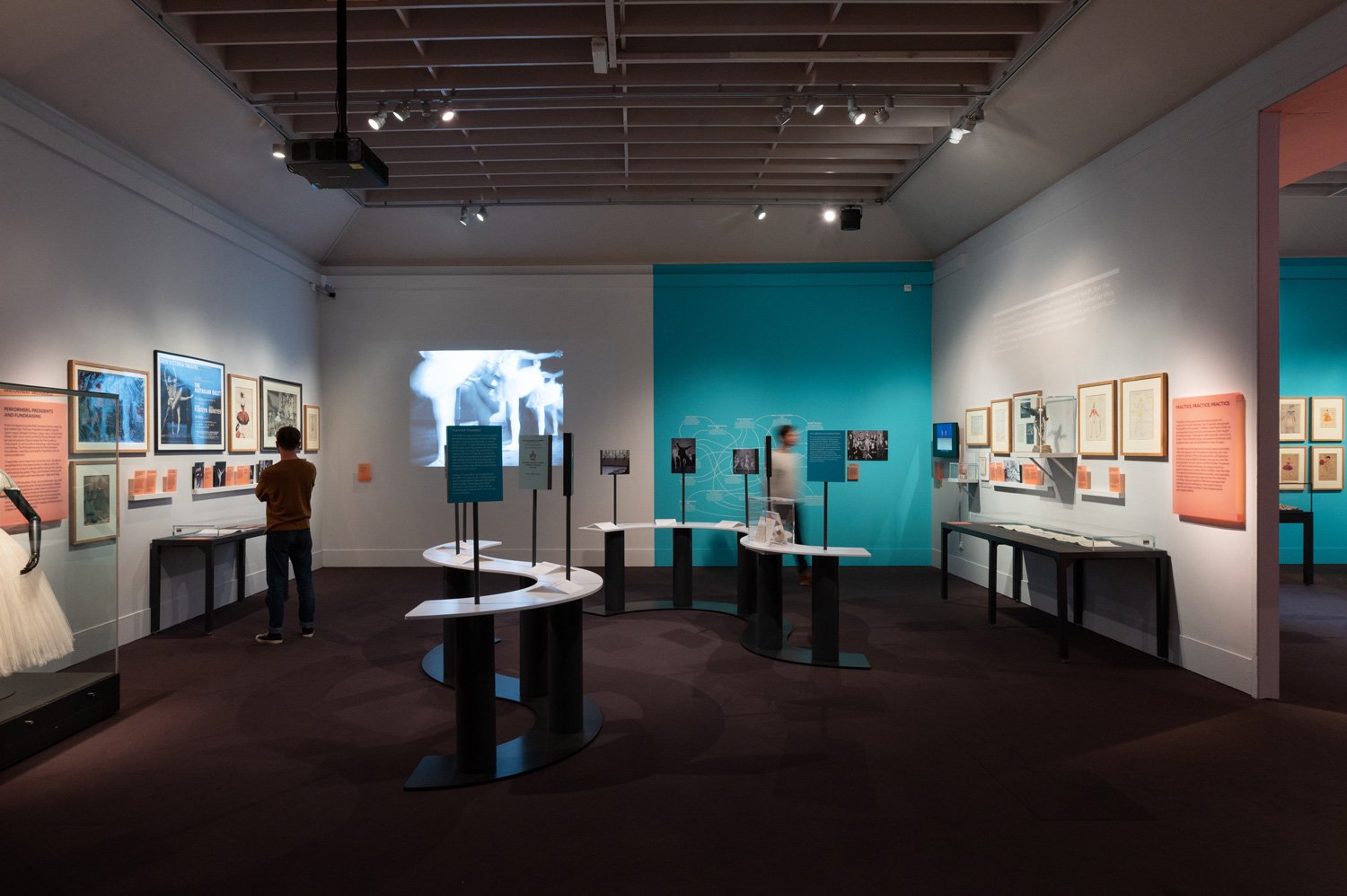
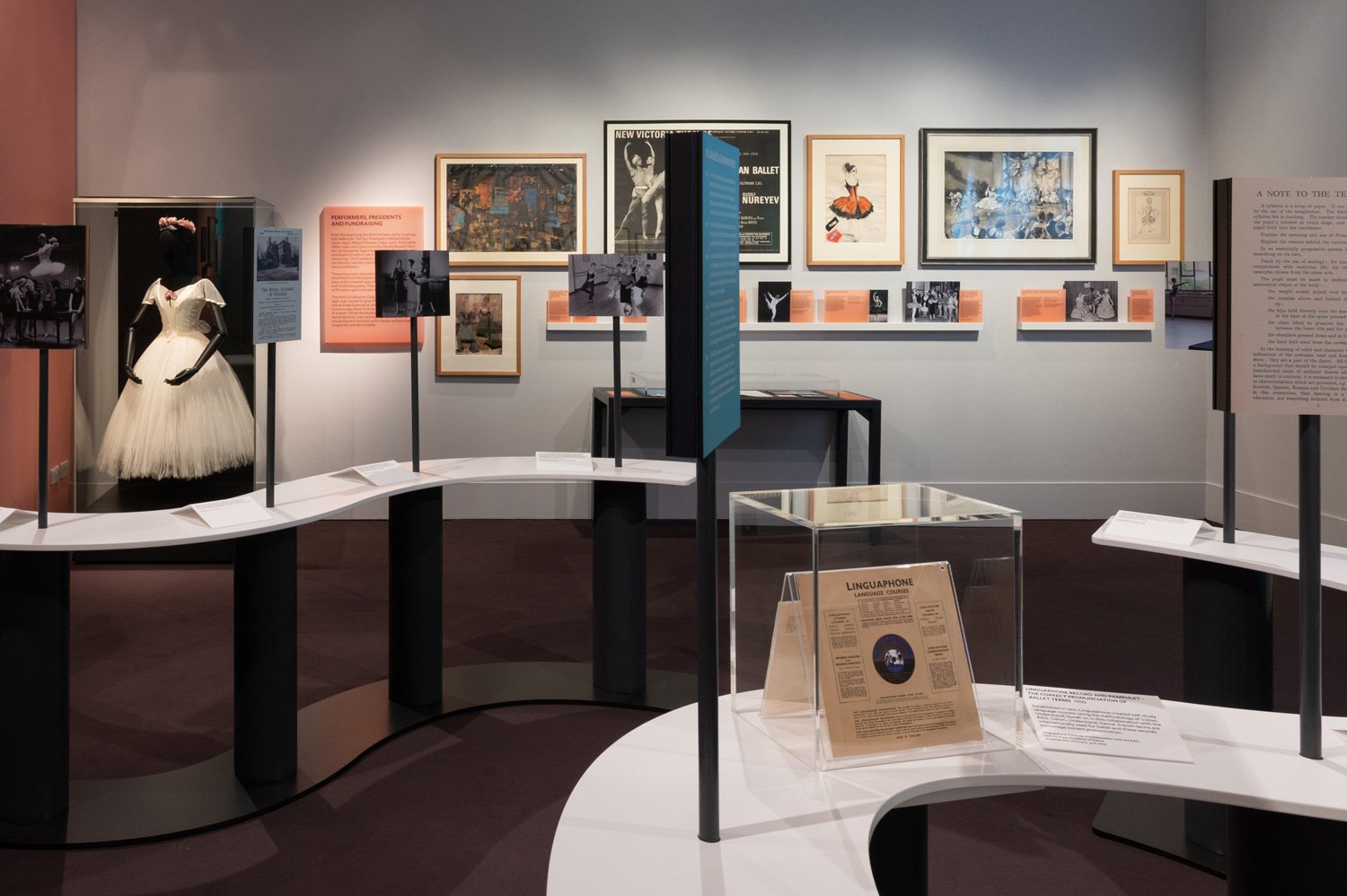
Within the display, the concept of the line is expressed through a number of design features. Firstly, a series of narrow mounted display shelves evoke the form of a ballet training barre, and nods to the horizontality of a musical score. These shelves, or wall lines, have a sense of controlled movement, and serve as a versatile display system on which an array of imagery and captions can be slotted into grooves within the line profiles. The wall mounted showcases dialogue with the wall lines, retaining the same thickness and visual purity, uninterrupted by visible fixings.
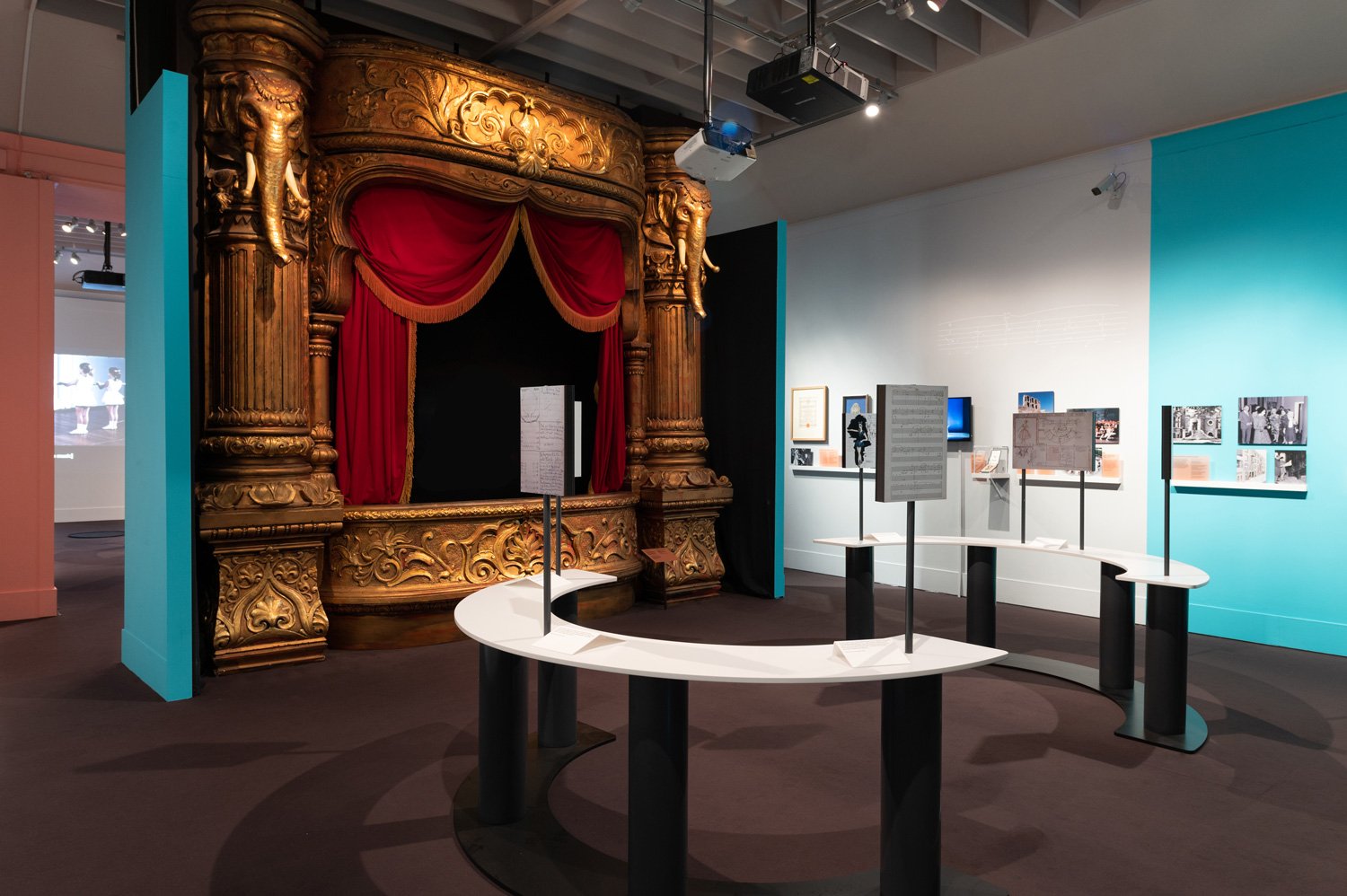
The second design gesture to reference the line motif is a series of linear tables. These six tables are positioned in pairs in the centre of each of the three rooms. The tables are more curvaceous and fluid in form than the wall lines, and create an informal sense of zoning and spatial presence, as well as providing additional display space. The table lines host imagery, poised on narrow stems, and also feature embedded showcases and captions upon the table surface. The linear form of the table is accentuated by dramatic use of white, which contrasts with a dark base and legs that appear to recede into the floor.
Around the half-way point in the display the visitor encounters a ballet studio area, which is recreated with a sprung floor, full height mirror and double barre set at the regulation height of 1150mm. From the inception of the project, through concepting and curatorial discussions, there was a strong sense that a display focussed on dance should offer visitors the opportunity to dance. Whilst at the barre, visitors can attempt to recreate classic ballet poses, guided by an RAD video, showcasing excerpts of the Academy’s ballet syllabus.
The colour palette nods to a colour often associated with ballet, pastel pink, which is offset by a contemporary use of teal and grey. The colours are applied as boldly contrasting blocks throughout the three rooms of the display. Pastel pink reappears in the form of frosted acrylic captions and sections intros, whilst a number of super graphics provide a life-size look into the history of the RAD.
The design of the display aims to balance the rich history of the organisation with its contemporary approach to ballet and dance. It does so by evoking a sense of movement with a modern attitude and refined design details – celebrating the past and present of the Royal Academy of Dance with an eye on its enduring relevance in the future.
ON POINT
Client: Victoria & Albert Museum
Project Partner: Royal Academy of Dance
Design: Dean Brown & Jon Abbott
Photography: Tian Khee Siong
Date: May 2020
On Point is a free display at the V&A which charts the hundred-year history of the Royal Academy of Dance. The 230sqm display runs across three rooms of the V&A’s Theatre and Performance galleries, showcasing objects, costumes, AV projections, original prints and reproduction images.
Designers Jon Abbott and Dean Brown worked collaboratively to present a vision for the display, which was inspired by visual representations of movement. The design concept centres around the concept of the line, from the parallel lines of a musical stave to the physical line of a dancer (the classical ballet term line describes the complete outline of a dancer’s body while performing steps or poses).
Within the display, the concept of the line is expressed through a number of design features. Firstly, a series of narrow mounted display shelves evoke the form of a ballet training barre, and nods to the horizontality of a musical score. These shelves, or wall lines, have a sense of controlled movement, and serve as a versatile display system on which an array of imagery and captions can be slotted into grooves within the line profiles. The wall mounted showcases dialogue with the wall lines, retaining the same thickness and visual purity, uninterrupted by visible fixings.
The second design gesture to reference the line motif is a series of linear tables. These six tables are positioned in pairs in the centre of each of the three rooms. The tables are more curvaceous and fluid in form than the wall lines, and create an informal sense of zoning and spatial presence, as well as providing additional display space. The table lines host imagery, poised on narrow stems, and also feature embedded showcases and captions upon the table surface. The linear form of the table is accentuated by dramatic use of white, which contrasts with a dark base and legs that appear to recede into the floor.
Around the half-way point in the display the visitor encounters a ballet studio area, which is recreated with a sprung floor, full height mirror and double barre set at the regulation height of 1150mm. From the inception of the project, through concepting and curatorial discussions, there was a strong sense that a display focussed on dance should offer visitors the opportunity to dance. Whilst at the barre, visitors can attempt to recreate classic ballet poses, guided by an RAD video, showcasing excerpts of the Academy’s ballet syllabus.
The colour palette nods to a colour often associated with ballet, pastel pink, which is offset by a contemporary use of teal and grey. The colours are applied as boldly contrasting blocks throughout the three rooms of the display. Pastel pink reappears in the form of frosted acrylic captions and sections intros, whilst a number of super graphics provide a life-size look into the history of the RAD.
The design of the display aims to balance the rich history of the organisation with its contemporary approach to ballet and dance. It does so by evoking a sense of movement with a modern attitude and refined design details – celebrating the past and present of the Royal Academy of Dance with an eye on its enduring relevance in the future.
ON POINT
Client: Victoria & Albert Museum
Project Partner: Royal Academy of Dance
Design: Dean Brown & Jon Abbott
Photography: Tian Khee Siong
Date: May 2020
On Point is a free display at the V&A which charts the hundred-year history of the Royal Academy of Dance. The 230sqm display runs across three rooms of the V&A’s Theatre and Performance galleries, showcasing objects, costumes, AV projections, original prints and reproduction images.
Designers Jon Abbott and Dean Brown worked collaboratively to present a vision for the display, which was inspired by visual representations of movement. The design concept centres around the concept of the line, from the parallel lines of a musical stave to the physical line of a dancer (the classical ballet term line describes the complete outline of a dancer’s body while performing steps or poses).
Within the display, the concept of the line is expressed through a number of design features. Firstly, a series of narrow mounted display shelves evoke the form of a ballet training barre, and nods to the horizontality of a musical score. These shelves, or wall lines, have a sense of controlled movement, and serve as a versatile display system on which an array of imagery and captions can be slotted into grooves within the line profiles. The wall mounted showcases dialogue with the wall lines, retaining the same thickness and visual purity, uninterrupted by visible fixings.
The second design gesture to reference the line motif is a series of linear tables. These six tables are positioned in pairs in the centre of each of the three rooms. The tables are more curvaceous and fluid in form than the wall lines, and create an informal sense of zoning and spatial presence, as well as providing additional display space. The table lines host imagery, poised on narrow stems, and also feature embedded showcases and captions upon the table surface. The linear form of the table is accentuated by dramatic use of white, which contrasts with a dark base and legs that appear to recede into the floor.
Around the half-way point in the display the visitor encounters a ballet studio area, which is recreated with a sprung floor, full height mirror and double barre set at the regulation height of 1150mm. From the inception of the project, through concepting and curatorial discussions, there was a strong sense that a display focussed on dance should offer visitors the opportunity to dance. Whilst at the barre, visitors can attempt to recreate classic ballet poses, guided by an RAD video, showcasing excerpts of the Academy’s ballet syllabus.
The colour palette nods to a colour often associated with ballet, pastel pink, which is offset by a contemporary use of teal and grey. The colours are applied as boldly contrasting blocks throughout the three rooms of the display. Pastel pink reappears in the form of frosted acrylic captions and sections intros, whilst a number of super graphics provide a life-size look into the history of the RAD.
The design of the display aims to balance the rich history of the organisation with its contemporary approach to ballet and dance. It does so by evoking a sense of movement with a modern attitude and refined design details – celebrating the past and present of the Royal Academy of Dance with an eye on its enduring relevance in the future.
ON POINT
Client: Victoria & Albert Museum
Project Partner: Royal Academy of Dance
Design: Dean Brown & Jon Abbott
Photography: Tian Khee Siong
Date: May 2020
On Point is a free display at the V&A which charts the hundred-year history of the Royal Academy of Dance. The 230sqm display runs across three rooms of the V&A’s Theatre and Performance galleries, showcasing objects, costumes, AV projections, original prints and reproduction images.
Designers Jon Abbott and Dean Brown worked collaboratively to present a vision for the display, which was inspired by visual representations of movement. The design concept centres around the concept of the line, from the parallel lines of a musical stave to the physical line of a dancer (the classical ballet term line describes the complete outline of a dancer’s body while performing steps or poses).
Within the display, the concept of the line is expressed through a number of design features. Firstly, a series of narrow mounted display shelves evoke the form of a ballet training barre, and nods to the horizontality of a musical score. These shelves, or wall lines, have a sense of controlled movement, and serve as a versatile display system on which an array of imagery and captions can be slotted into grooves within the line profiles. The wall mounted showcases dialogue with the wall lines, retaining the same thickness and visual purity, uninterrupted by visible fixings.
The second design gesture to reference the line motif is a series of linear tables. These six tables are positioned in pairs in the centre of each of the three rooms. The tables are more curvaceous and fluid in form than the wall lines, and create an informal sense of zoning and spatial presence, as well as providing additional display space. The table lines host imagery, poised on narrow stems, and also feature embedded showcases and captions upon the table surface. The linear form of the table is accentuated by dramatic use of white, which contrasts with a dark base and legs that appear to recede into the floor.
Around the half-way point in the display the visitor encounters a ballet studio area, which is recreated with a sprung floor, full height mirror and double barre set at the regulation height of 1150mm. From the inception of the project, through concepting and curatorial discussions, there was a strong sense that a display focussed on dance should offer visitors the opportunity to dance. Whilst at the barre, visitors can attempt to recreate classic ballet poses, guided by an RAD video, showcasing excerpts of the Academy’s ballet syllabus.
The colour palette nods to a colour often associated with ballet, pastel pink, which is offset by a contemporary use of teal and grey. The colours are applied as boldly contrasting blocks throughout the three rooms of the display. Pastel pink reappears in the form of frosted acrylic captions and sections intros, whilst a number of super graphics provide a life-size look into the history of the RAD.
The design of the display aims to balance the rich history of the organisation with its contemporary approach to ballet and dance. It does so by evoking a sense of movement with a modern attitude and refined design details – celebrating the past and present of the Royal Academy of Dance with an eye on its enduring relevance in the future.

ON POINT
Client: Victoria & Albert Museum
Project Partner: Royal Academy of Dance
Design: Dean Brown & Jon Abbot
Photography: Tian Khee Siong
Date: May 2020
On Point is a free display at the V&A which charts the hundred-year history of the Royal Academy of Dance. The 230sqm display runs across three rooms of the V&A’s Theatre and Performance galleries, showcasing objects, costumes, AV projections, original prints and reproduction images.
Designers Jon Abbott and Dean Brown worked collaboratively to present a vision for the display, which was inspired by visual representations of movement. The design concept centres around the concept of the line, from the parallel lines of a musical stave to the physical line of a dancer (the classical ballet term line describes the complete outline of a dancer’s body while performing steps or poses).
Within the display, the concept of the line is expressed through a number of design features. Firstly, a series of narrow mounted display shelves evoke the form of a ballet training barre, and nods to the horizontality of a musical score. These shelves, or wall lines, have a sense of controlled movement, and serve as a versatile display system on which an array of imagery and captions can be slotted into grooves within the line profiles. The wall mounted showcases dialogue with the wall lines, retaining the same thickness and visual purity, uninterrupted by visible fixings.
The second design gesture to reference the line motif is a series of linear tables. These six tables are positioned in pairs in the centre of each of the three rooms. The tables are more curvaceous and fluid in form than the wall lines, and create an informal sense of zoning and spatial presence, as well as providing additional display space. The table lines host imagery, poised on narrow stems, and also feature embedded showcases and captions upon the table surface. The linear form of the table is accentuated by dramatic use of white, which contrasts with a dark base and legs that appear to recede into the floor.
Around the half-way point in the display the visitor encounters a ballet studio area, which is recreated with a sprung floor, full height mirror and double barre set at the regulation height of 1150mm. From the inception of the project, through concepting and curatorial discussions, there was a strong sense that a display focussed on dance should offer visitors the opportunity to dance. Whilst at the barre, visitors can attempt to recreate classic ballet poses, guided by an RAD video, showcasing excerpts of the Academy’s ballet syllabus.
The colour palette nods to a colour often associated with ballet, pastel pink, which is offset by a contemporary use of teal and grey. The colours are applied as boldly contrasting blocks throughout the three rooms of the display. Pastel pink reappears in the form of frosted acrylic captions and sections intros, whilst a number of super graphics provide a life-size look into the history of the RAD.
The design of the display aims to balance the rich history of the organisation with its contemporary approach to ballet and dance. It does so by evoking a sense of movement with a modern attitude and refined design details – celebrating the past and present of the Royal Academy of Dance with an eye on its enduring relevance in the future.

ON POINT
Client: Victoria & Albert Museum
Project Partner: Royal Academy of Dance
Design: Dean Brown & Jon Abbott
Photography: Tian Khee Siong
Date: May 2020
On Point is a free display at the V&A which charts the hundred-year history of the Royal Academy of Dance. The 230sqm display runs across three rooms of the V&A’s Theatre and Performance galleries, showcasing objects, costumes, AV projections, original prints and reproduction images.
Designers Jon Abbott and Dean Brown worked collaboratively to present a vision for the display, which was inspired by visual representations of movement. The design concept centres around the concept of the line, from the parallel lines of a musical stave to the physical line of a dancer (the classical ballet term line describes the complete outline of a dancer’s body while performing steps or poses).
Within the display, the concept of the line is expressed through a number of design features. Firstly, a series of narrow mounted display shelves evoke the form of a ballet training barre, and nods to the horizontality of a musical score. These shelves, or wall lines, have a sense of controlled movement, and serve as a versatile display system on which an array of imagery and captions can be slotted into grooves within the line profiles. The wall mounted showcases dialogue with the wall lines, retaining the same thickness and visual purity, uninterrupted by visible fixings.
The second design gesture to reference the line motif is a series of linear tables. These six tables are positioned in pairs in the centre of each of the three rooms. The tables are more curvaceous and fluid in form than the wall lines, and create an informal sense of zoning and spatial presence, as well as providing additional display space. The table lines host imagery, poised on narrow stems, and also feature embedded showcases and captions upon the table surface. The linear form of the table is accentuated by dramatic use of white, which contrasts with a dark base and legs that appear to recede into the floor.
Around the half-way point in the display the visitor encounters a ballet studio area, which is recreated with a sprung floor, full height mirror and double barre set at the regulation height of 1150mm. From the inception of the project, through concepting and curatorial discussions, there was a strong sense that a display focussed on dance should offer visitors the opportunity to dance. Whilst at the barre, visitors can attempt to recreate classic ballet poses, guided by an RAD video, showcasing excerpts of the Academy’s ballet syllabus.
The colour palette nods to a colour often associated with ballet, pastel pink, which is offset by a contemporary use of teal and grey. The colours are applied as boldly contrasting blocks throughout the three rooms of the display. Pastel pink reappears in the form of frosted acrylic captions and sections intros, whilst a number of super graphics provide a life-size look into the history of the RAD.
The design of the display aims to balance the rich history of the organisation with its contemporary approach to ballet and dance. It does so by evoking a sense of movement with a modern attitude and refined design details – celebrating the past and present of the Royal Academy of Dance with an eye on its enduring relevance in the future.
On Point, Victoria & Albert Museum